Harare mayor Mafume arrested, MDC sees plan to install Zanu PF proxy

HARARE – Harare mayor Jacob Mafume was arrested on Wednesday accused of criminal abuse of office over the allocation of housing stands, his lawyer said.

His party said it was “yet another case of persecution and weaponisation of the law against MDC Alliance members.”

Lawyer Tonderai Bhatasara said: “The charge is criminal abuse of office arising from the allocation of housing stands in Westlea in March 2020. The charges are denied.”

Mafume, the Ward 17 councillor in Harare covering the Mt Pleasant area, was elected mayor in September after a faction of the MDC backed by Zanu PF recalled former mayor Herbert Gomba and over a dozen other councillors.

He narrowly beat the candidate of the MDC-T party, who was being supported by Zanu PF – but the fight for the control of the capital has not abetted, amid reports that Zanu PF is angling to replace the MDC Alliance council with a commission.

Earlier this month, anti-corruption police arrested 21 councillors during a full council meeting on corruption charges. Mafume was not among them.

The MDC Alliance said in a statement: “We know that his real offence was winning the mayoral vote for the MDC Alliance. The toxic politics of Zanu PF is aimed at persecuting those who openly display allegiance with President Nelson Chamisa. They want to remove him and replace him with a Zanu PF proxy.”

Mafume is expected to appear in court on Thursday.

Police to pay Z$4.3 million over 2019 fuel riots killing of footballer

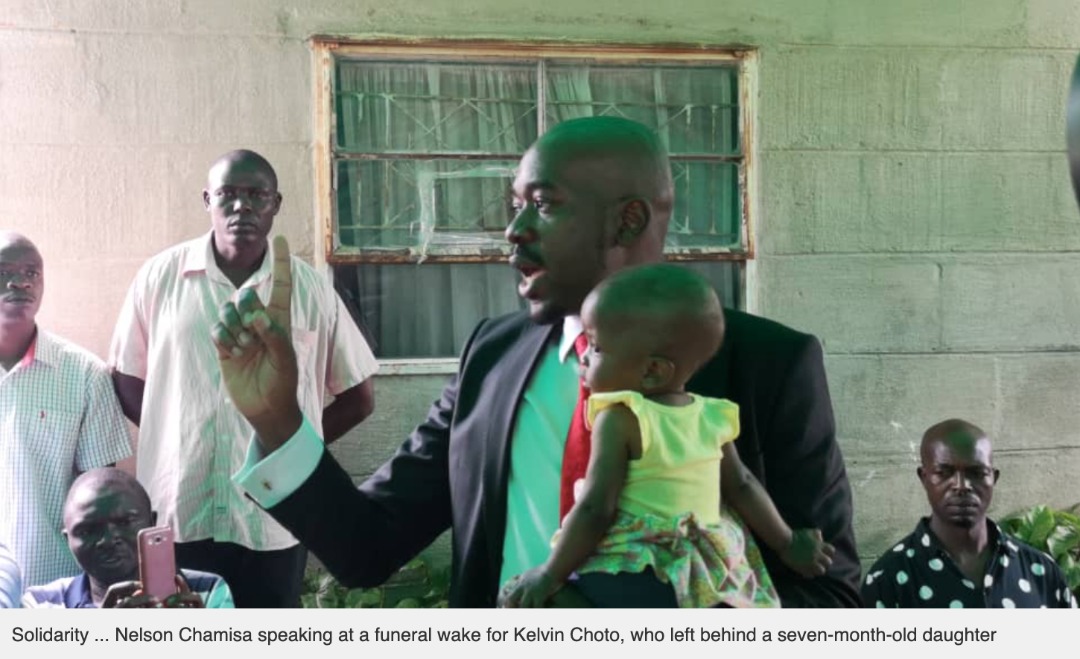
HARARE – Police have been ordered to pay Z$4.3 million (US$35,833) to the family of a promising footballer who was shot dead during protests over sharp fuel price increases in January 2019.

Kelvin Tinashe Choto, 22, was shot in the head during protests in Chitungwiza on January 14.

Rights groups documented 22 other similar killings by security forces, while over 74 other people were left nursing gunshot wounds. None of the police officer or soldiers involved in the killings have been charged.

On Wednesday, Justice Edith Mushore ruled that Choto’s killing was unlawful, and awarded damages to his father Julius Choto and widow, Varaidzo Chiyanike.

The family sued the police, the home affairs minister and Constable Rachid Siri, who fired the fatal shot.

Harare lawyer Fiona Iliff of the Zimbabwe Lawyers for Human Rights represented Choto’s family.

She said Kelvin was an “innocent bystander” as protesters clashed with police.

2 pilots killed in military jet crash in Gweru, journalists detained for filming

GWERU – An Air Force of Zimbabwe aircraft on a training exercise crashed in Gweru on Tuesday, killing its two pilots.

Two journalists were detained by the military for four hours after taking pictures of the wreckage near the railway interchange at Dabuka.

Eyewitnesses said the aircraft, which had taken off from the Thornhill Air Base, now renamed Josiah Tungamirai Air Force Base, crashed just after 2PM while attempting to turn back.

One said: “The plane went into a spin and then a dive to the ground, nose first.”

Wreckage of the aircraft showed its landing gear up. The two pilots, named as flight instructor Mkhululi Dube and his female trainee, Silungile Sweswe, died on impact.

Military police arrived at the scene 30 minutes after the crash and cordoned off the area.

Two journalists from The Chronicle and the Masvingo Mirror were detained for four hours after taking pictures of the wreckage. They were freed without charge after being forced to delete their pictures.

Thornhill Air Base is the home of Zimbabwe’s Air Force. Gweru residents are regularly treated to air displays as the next fighter pilots undergo training and others fine-tune their acquired skills.

The type of aircraft involved has not been revealed by the military, which parried media enquiries on Tuesday. But Zimbabwe, a former British colony, still flies British-manufactured military jets which it has not been able to fully service since 2002 when the European Union slapped the country with an arms embargo over human rights abuses.

Inmate tells High Court of major health crisis at Chikurubi prison

HARARE – Chikurubi Maximum Security Prison is facing a major outbreak of diarrhoea, TB and hepatitis B, an inmate has revealed in a High Court action.

Prisoner Tautai Dzodzo says the facility which was designed to carry 1,360 inmates currently has over 2,000 prisoners. At least 500 inmates share two toilets, but the prison complex has had no running water since November 8 following a power outage that has affected pumping.

“The shortage of water has resulted in an outbreak of serious diseases including diarrhoea, hepatitis B and tuberculosis. Regrettably, prison officials do not separate sick prisoners from the healthy ones,” Dodzo said in an affidavit filed at the Harare High Court on Monday, seeking an order for prison authorities to be compelled to improve conditions.

Prisoners are also at risk of contracting Covid-19 as they share crowded cells, with no social distancing being observed per World Health Organisation guidelines.

Cited as respondents are prisons boss Commissioner General Moses Chihobvu, justice minister Ziyambi Ziyambi, agriculture minister Anxious Masuka, finance minister Mthuli Ncube and the Zimbabwe Human Rights Commission.

“The first respondent (Chinobvu) certainly does not feed us at Chikurubi Maximum Security Prison with the diet that is laid out in relevant regulations and Instruments linked to the Prisons Act,” Dodzo added in his application.

“That failure is therefore a violation of the law, an infringement that must now be rectified urgently given the heightened risk to health and welfare of prisoners that has emerged from the current water crisis.”

The prisoner is being represented by lawyers instructed by the Zimbabwe Human Rights NGO Forum.

Dodzo urgently wants prison authorities to put temporary measures in place to improve access to water which includes the deployment of mobile water bowsers, and for ill prisoners to be separated from the healthy ones.

He also wants Ncube ordered to immediately release funds for supplementary daily water supplies to the jail and the prison clinic to be fully stocked with all essential medicines and the requisite technology.

He told the High Court that inmates now rely on relatives to bring them drinking water.

Prisoners now fetch water from an open pond within the prison complex for all other purposes, the court heard.

MDC Alliance Bulawayo chairwoman says Muchehiwa was abducted for planning to bomb govt buildings, received funding from America

BULAWAYO – MDC Alliance Bulawayo women’s wing chairperson Tendai Masotcha has claimed that Tawanda Muchehiwa was abducted by state security agents after they uncovered his role in an alleged plot to bomb government buildings.

In an audio recording circulated Monday evening, Masotsha said she had warned Nelson Chamisa’s righthand man, Jameson Timba, that she would soon go public with the terrorism claims if the party did not persuade ZimLive editor Mduduzi Mathuthu, Muchehiwa’s uncle, to stop linking her to the abduction.

“Ndakamutaurira Timba kuti vakaramba vachindiisa mukona ndinotaura zvese kuti vaida kuita bomb government buildings uye kuti ane vanhu 20 vaida kumubetsera (I told Timba that if they continue pushing me into a corner, I will reveal everything and their plans to bomb government buildings. Tawanda told me he had 20 other people who were going to help him)”), she says in the recording (video above).

The audio recording will raise fresh headaches for the party with questions as to why Masotsha, a senior party leader, would have kept information about an alleged terrorist plot away the security department.

Masotsha is also accused of refusing to cooperate with MISA lawyers as they battled to file a habaes corpus application, following Muchehiwa’s abduction. At the time, she was the only witness to the abduction but refused to put on record that the intelligence operative who had later taken her to Bulawayo police station was the same man who had seized Muchehiwa from the vehicle from which they were sitting together.

Despite Masotsha being cleared to return to party work by Harare, newly released documents show sharp differences with Bulawayo about her role in the abduction with calls for her to be removed from her position.

Flyers distributed by Masotsha at the time, calling for protestors to “attack the police in the homes”, remain central to questions about her motives with fears she was working to entrap party activists and lend credence to claims by government that the July 31 protest was going to be violent.

“We now fear Leader Tendai, fear her behaviour and recommend that the National Disciplinary Committee formally compels her to reveal the real source/s of the subversive flier, what the source or sources’ intention were and who printed the fliers. Indeed, we want know where the fliers are from?” provincial secretary Alderman Eanerst Rafomoyo said in a September 1 internal party communication copied to party leader Nelson Chamisa, secretary general Charlton Hwende and spokesperson Fadzayi Mahere recommending Masotsha’s expulsion from the party.

The MDC Alliance had refused to answer any further media questions on the matter.

Teachers say receiving threats from Zanu PF sponsored group

HARARE – Teachers yesterday claimed that were being threatened a Zanu PF sponsored group led by Martin Mazivisa.

Mazivisa fronts a shadowy parents union called Zimbabwe Parents Union (ZPU), which has been trying to force teachers to return to work.

ZPU was recently endorsed by Labour minister Paul Mavima.

The teachers allege that Mazivisa, who claims to be well-connected, has been sending threatening messages to teachers’ unions that have refused to accept government’s 41% salary offer. In the massages, Mazivisa is said to have threatened to unleash Zanu PF youths to “deal with them”.

He is also being accused of joining teachers unions’ WhatsApp groups and threatening them with unspecified action.

This comes at a time some teachers’ unions have refused to return to work until government agrees to their US$520 salary demand. They also said there has been a rise in cases of COVID-19 at schools, which exposes them to the virus.

Progressive Teachers’ Union of Zimbabwe (PTUZ) national co-ordinator Harison Mudzuri said his union would not be moved by Mazivisa’s threats.

Mudzuri said political parties should not involve themselves in salary disputes between government and its employees.

The PTUZ official said by refusing to return to work, teachers were not playing politics, but raising genuine grievances.

“The PTUZ has received reports of teachers that are being threatened with unspecified action by people from a certain political grouping for exercising their constitutional rights,” Mudzuri said.

A teacher interviewed by NewsDay, who refused to be named, said Mazivisa had threatened them.

“Mazivisa is always abusing the Zanu PF party name by threatening teachers. In fact, he is building his political career through abusing teachers by mobilising parents against them. He is canvassing for the Mhondoro constituency seat in the forthcoming 2023 harmonised elections and is trying to endear himself with the party,” the teacher said.

In response, Mazivisa told NewsDay that teachers should not expect salaries if they did not return to work.

“I have no political ambitions as alleged, but I am a nation builder. These teachers are trying hard to derail President Emmerson Mnangagwa’s plans by pushing the opposition agenda, but our position as parents is that we are telling them to go back to work while the government addresses their grievances because government increased their salaries to Z$19,000 (US$158),” Mazivisa said.

While teachers affiliated to the PTUZ and the Amalgamated Rural Teachers Union (Artuz) have refused to return to work despite the salary hike, cases of COVID-19 being recorded at various schools across the country have been cited as a cause for concern.

John Tallach, a mission-run school in Matabeleland North recorded 122 COVID-19 positive cases, while schools in Masvingo and other areas have also recorded positive cases.

However, the chief co-ordinator on COVID-19 in the Office of the President and Cabinet Agnes Mahomva assured NewsDay that there was no need for panic.

She denied claims of COVID-19 positive cases at Prince Edward High School in Harare.

“In terms of schools remaining open, we are progressing very well. If we get cases in one corner, do we suddenly lock out everything? Not really. You look, you investigate and just like I said we investigate and then we talk about the evidence.

“We also don’t want to jeopardise other schools that are following all our guidelines and our standard operating procedures and nothing is happening there,” Mahomva said.

She said the continued closure of schools would be tantamount to punishing students who would be deprived of education.

Sikhala Acquitted, Judge Says It Was His Right To Call For ED’s Removal

OUTSPOKEN MDC Vice Chairperson, Job Sikhala was Friday acquitted at the Masvingo High Court where he was facing subversion charges for threatening to remove President Emmerson Mnangagwa from office before 2023.

He was acquitted after his defence counsel led by top human rights lawyer, Beatrice Mtetwa, made an application for Sikhala not to be put on trial.  

Sikhala was arrested last year after addressing a rally in Bikita where he is alleged to have called for the unconstitutional removal of Mnangagwa from office.

However, in handing down his judgment, Justice Garainesu Mawadze noted that the court cannot put Sikhala on trial based on the case built by the State. He said the State had based its case on statements they took out of context.

The judge said it was not a criminal offence to have intentions of overthrowing a government, although it had to be carried out using constitutional means. He added Sikhala was exercising his constitutional right as a politician when he uttered the words.

Justice Mawadze also blasted the State for failing to understand the difference between overthrowing a president as an individual and as a government. 

Charges against Sikhala arose in Bikita last December when he told MDC supporters at a rally that Mnangagwa would be removed from office before 2023.

Zimbabwe state intelligence, abductions, and modus operandi

I HAVE previously gone on several drinking sprees with the former deputy director of the Central Intelligence Organisation (CIO), Menard Muzariri.

I was introduced to him by a mutual friend. When he knew that I was with the Police Protection Unit (PPU) and also from Mt Darwin, we hit it off! We partied in the usual night spots in Harare and Chitungwiza and he would occasionally summon me to go and look for women for him! One time we partied with some South African intelligence operatives whom he introduced to me. He never talked work and I would never dare ask him questions. At that time I was not aware of his role in the Gukurahundi democide. These experiences and other interactions with intelligence, forensics, and policing personnel whetted my curiosity in those fields.

The Zimbabwean state, since it came into being after independence from Britain in 1980, has been known for various democides which include political violence, crimes against humanity, state-sanctioned murder, violence and illegal mining atrocities.

The purpose of this opinion piece is to outline the contemporary state intelligence tactics, structure, resources and modus operandi in relation to murders and abductions in Zimbabwe. I will primarily focus on the CIO. The paper will also elucidate some of the actions and profiles of other perpetrators such as the Zimbabwe National Army (ZNA), Zimbabwe Republic Police (ZRP), War Veterans (WV) and Zanu PF Youth Wing (YW).

The present CIO, formerly the Special Branch, came into being in 1981 and was headed by Ken Flower until his retirement in 1984. The Special Branch was responsible to the Deputy Commissioner (Crime and Security prior to its incorporation into the President’s Office). The present CIO boss is Isaac Moyo and is deputised by Brigadier-General Walter Tapfumaneyi and former National University of Science and Technology Pro-Vice-Chancellor Gatsha Mazithulela. Between the two of them they supervise various key branches—such as internal, external, counter-intelligence, military intelligence, training, close protection unit, technical, training, administration and another simply known as Branch Six. In addition, there are desks on social media, trade unions, projects, terrorism, and propaganda.

There are currently around 3 500 full-time staff and around 2 000 part-time “assets” deployed mostly in Zimbabwe. There are also operatives in most African countries and in Europe. In terms of locations where they operate from, a decade ago SW Radio Africa published a credible list which is found here. In addition to these locations like most intelligence agencies around the world, the CIO has safe houses and farms dotted around the country. As readers might be aware, Zimbabwe was listed as one of the countries which the CIA used for renditions. This is the abduction and torture of suspects by the CIA carried out in other countries with permission.

Before discussing the shenanigans of the Zimbabwe intelligence service, let us discuss briefly how a professional service like this should function. Firstly, it should not be based in the Office of the President for obvious reasons such as bias, corruption, misuse and manipulation. Hallmarks of the present CIO. The purpose of a professional intelligence service is to gather intelligence, manage information, work on evidence and disclosure, and support other security services. In Zimbabwe, as this paper will demonstrate, the CIO literally serves at the pleasure of the President. However, I must admit not all intelligence services are 100% professional, the extent to which they are dubious is the problem in Zimbabwe.

Now readers might want to know what intelligence is. The CIA (1999), defines intelligence as knowledge and foreknowledge of an individual’s or entity’s surroundings used for present and future decision making and action. Intelligence can also be viewed as actions or processes used to produce knowledge. Global Intelligence Working Group (2003) defines law enforcement intelligence as the acquisition and analysis of information to produce intelligence which can be used for decision making.

There are plenty of examples within Zimbabwean contexts that can be used to illustrate some of these definitions. Take the Catholic Church’s former archbishop of Bulawayo province, Pius Ncube. The CIO had information that, despite his being a devout priest, he had a weakness for the ladies. They had this information for years and were waiting for the right opportunity to use that information (intelligence) to shut his anti-Mugabe stance down. And they used that, albeit successfully, I should say. Readers can think of dozens of other examples of such successful use of information, particularly against politically connected individuals. Remember former Vice-President Joice Mujuru previously mentioning that Mugabe has files on everyone. This is the kind of information that they have.

So how is intelligence of ordinary citizens collected by the CIO? This is done covertly, overtly, through social media, some of it comes through the ZRP, ZNA and paid informers. Covert intelligence is information gathered through undercover, technical surveillance, and pseudo operations. Zimbabwean CIO operatives like being known and most of them are not exactly discreet. There are various videos of human rights defenders (HRD) who have been followed by operatives and subsequently filmed them.

The Namatai Kwekweza video is one such example. The purpose of such aggressive form of surveillance is to intimidate and to distract the individual. What sort of intelligence or information does the CIO collect? Well, they note everything from shoe size, clothing, friends, family drinking habits, sporting activities, vehicles used, work, addresses and, in some extreme cases, they can collect DNA. This information is often fed into a software system, analysed, rated for use, or marinated. Marination is when any useful information is kept for future use.

Let me give you a practical example below on how that information looks like presently. Previously, intelligence was kept on index cards which took ages to search and input intelligence.

Let us cite the example of well-known journalist Hopewell Chin’ono. What does his profile look like on their system? Here is an example:

Pictures Addresses Associates Vehicle Crimes Intelligence and Operations
Schematic of CIO intelligence system.

Each of the above tabs will be interactive and when you click on them they will show you further contents associated with an individual. In addition, as you go from left to right, depending on operational level of clearance, one will not be able to see certain information. The intelligence section is the most populated as it will contain detailed descriptive intelligence on an individual. For high-profile individuals, there might be daily updates or intelligence. If there is a high level of intelligence from multiple sources, this will force the analyst to make actionable decisions. This can be either an arrest, abduction, warning or assault etc. So what do most intelligent notes look like? Here is an example:

On 05/10/2020 Chin’ono was seen in the company of Jacob Ngarivhume at Belgravia shops at approx. 3pm. Hopewell was wearing blue jeans, grey t shirt and black shoes. Jacob was wearing blue trousers, grey shirt, and white trainers. The long range listening device was not working hence could not hear conversation. Both individuals stayed at the shops for approximately 2 hours and left in their respective vehicles which are already on file

When this information has been sent, it then becomes rated according to the source of information, intelligence evaluation, information content, and risk assessment. Also, as demonstrated information is easily falsified, politicised, and accepted. If you look at the history of all opposition leaders from Joshua Nkomo to Nelson Chamisa, most of the intelligence gathered against them is false and grossly exaggerated. Recent statements by security Minister Owen Ncube about Operation Light House is one such example.

If the intelligence is correct and further investigation were done, why then not arrest the individuals in question or mount an operation? In Zimbabwean contexts, detailed surveillance of individuals is limited to high-profile individuals found in opposition and human rights groups. Surveillance of Nelson Chamisa, for example, will be in technological terms and the use of operatives. Technological devices can be planted on vehicles, associates and can be unwittingly downloaded via clips in chat groups/social media which have a worm. I had the privilege of working at the US embassy in Harare during my PPU days. They sweep their vehicles for devices every single day. The devices used to check are readily available and some can be found here.

In terms of overt surveillance, operatives will normally be a six-men team, the two advance party (AP), static team (ST), and direct observation (DO) team. The DO team are the ones observable and have been reported numerous occasions by individuals being followed in Zimbabwe. The ST are static and normally are on the peripheral edges of a target. The AP team are the ones who know the route normally taken by a target and can be used often to intercept. The Sanderson Makombe incident can give you a loose indication on how the teams worked in the incident that ended up in two people dying. For “minor” individuals, the surveillance team will be smaller; as you can see, it is very expensive due to the number of people and resources involved.

Another important source of intelligence in contemporary contexts is social media and the hacking of phones. The CIO has a dedicated cyber unit which carries out offensive and defensive operations on selected targets. They have additional access to the military intelligence (MI) unit based at Mt Hampden as reported by Professor Jonathan Moyo. There are myths associated with what they can reasonably do or perform. They cannot hack your WhatsApp as it has end-to-end encryption. However, messages can be read before they are encrypted or after they are decrypted. That means any spyware dropped on the phone by an attacker could read the messages. Edward Snowdon encourages people to use other apps such as Signal. In addition, all companies and individuals who have local server emails are easily hacked. I remember telling Paston Dzamara about his email which he later changed. To demonstrate this, we can look at the Baba Jukwa investigation which led the then assistant police commissioner Crispen Makedenge nowhere.

Even Facebook messages are safe unless, of course, you have unwittingly downloaded spyware on your phone from a WhatsApp group, in which case they can read and see everything. In addition, unless you are a targeted individual, they do not have the capacity and personnel to carry out analysis of millions of people like what China does, for example. In terms of internet, the Tor browser is useful if you want to circumvent the prying eyes of the CIO. I am aware that Prof Moyo is currently banging on about the Mt Hampden listening centre which is apparently being manned by Group Captain Peacemaker Credo Kereke. However, as demonstrated previously, the CIO has not been able to effectively utilise those tools as they currently rely on abduction and the physical examination of devices. Readers might be reminded that big companies such as Facebook and Apple will not even supply information to the FBI.

Lastly, let us move on to the abduction and torture of individuals by the CIO. What is the plan, what do they do, and where do they take them? Since 2000, there has been more than 5 000 abductions by the state and associated organs.

Each respective state apparatus has an associated signature. However, I am going to focus on the CIO. The purpose of abduction is normally to scare, disable, or elicit information that otherwise was not obtained during normal surveillance methods, as discussed previously. Before an abduction takes place, intelligence is synthesised and an operation order is issued by a senior intelligence officer.

This order will contain information such as purpose, personnel, location, target, resources, risk assessment, and tactics. In addition, there will be trigger plans—these are the processes to implement in case something goes wrong. If we cite the example of Itai Dzamara, these processes were in place when he was abducted on 9 March 2015. I spoke to the late Patson Dzamara at that time a few weeks after Itai’s abduction and suggested they apply for mobile phone triangulation of his phone, but I believe the idea was shot down by the police. Itai’s mobile phone would have indicated who was travelling with him and where he was taken if the phone was on.

This I also strongly suggested in the Tawanda Muchehiwa abduction as the perpetrators used his phone to lure other victims. The nearest mobile phone mast to that location has details of individuals who were close to him. This is dependent on their mobiles being on. The state is aware what exactly happened as they have obfuscated the information at every turn. My theory on Itai Dzamara is that something went wrong during the abduction and torture, resulting in the officers in question implementing the trigger plan.

Let us discuss abductions using Harare as a snapshot in order to unpack tactics and locations. The way the CIO abduct, torture and leave individuals either dead or alive has explanations within psychological and criminological contexts and I have identified certain concepts. Routine activities theory (RAT), presupposes that for an offence to occur, three elements need to be present. That is, a motivated offender (CIO), suitable victim (human rights defender), and the absence of a capable guardian (ZRP). The optimal foraging theory (OFT) can be used as a theoretical framework for applying abduction site prediction modeling to aid in locating the missing. This will be illustrated briefly in the next section.

Offender profiling is guarded by two significant assumptions, consistency and homology theory. The consistency assumption suggests that perpetrators often repeat offences in an analogous fashion. This can partly explain the methods of various state entities in the massacres and abductions that have taken place in Zimbabwe. The 5 Brigade, for instance, were very consistent in their methodologies in searching, detaining and killing of people in Matabeleland.

The homology theory proposes that the way an offence is committed is related to background characteristics of the perpetrator (The more training, resources, time the offender has the greater the opportunities and severity of torture). We can use the Jestina Mukoko abduction as an example within that context. This can be explained in other various signature kidnappings by either MI, the Ferret Team/s or War Veterans.

Let us discuss these aspects using the dozens of abductions that have taken place in Harare in the last few years. If we look at the abductions of Jestina Mukoko, Patson Dzamara, Joana Madamombe, Peter Mugombeyi, Samantha Kureya, to name but a few, a pattern emerges. The location of torture and subsequent release are within an hour of Harare and include: Beatrice farming area, Mt Hampden (near Cyber Centre), Mazowe, Bindura, Seke/Dema junctions, Snake Park, Nyabira, Nharira Hills and Lake Chivero. Anyone can actually map this (I have a map!). The operatives are operating within their comfort zone in an analogous fashion. They also have a stand down area nearby and are familiar with the area. Now that the cat is slightly out of the bag, they might change tact! In forensic contexts there might be still a wealth of information which is available in these locations.

Another aspect with regards abductions of civilians in Zimbabwe is the issue of injection of unknown substances by the CIO. Examples of people who have been subjected to such methods include Job Sikhala and Mugombeyi. The CIO inherited personnel and equipment used by the Special Branch and other Rhodesian forces. As reported by Cross in Rhodesia and Chemical Biological Warfare 1975-1980, Zimbabwe had a chemical warfare unit which poisoned thousands of guerrillas in the liberation war. Curiously, if you look at the press release in the appointment of deputy director of the CIO, Dr Mazithulela, it states that he is the chairman of the National Authority on Chemical Weapons Convention! Now why is Zimbabwe in the convention and what chemical weapons do we have? So what substances are being injected into detainees? We know the CIA, the rendition colleagues of the CIO, use Scopolamine aka “Truth Serum”. Other substances are sodium thiopental and phenobarbital. If any of the barbiturates were administered to Joana Mamombe, for example, it might explain her present physical and mental health. People metabolise and respond differently to certain drugs.

In concluding this piece, it is important for human rights defenders and other victim groups to implement community safety and abduction prevention/mitigation measures. These can be found in countering some of the activities elucidated above. Examples is the use of smart bracelets and registering on the Sentinel project for satellite tracking. These are all legal and can be found in technological, psychological and simple security measures. So those concerned should data capture low-hanging fruits such as vehicles used, names published, and locations. There are also opportunities on the technological fronts in the phone of cleaning devices and use of virtual private networks (VPNs) as alert tool, using social media and a bit of journalistic work as demonstrated by Chin’ono.

Is the MDC Bulawayo women’s chair a CIO informant?

The MDC Alliance recently cleared its Bulawayo women’s wing chairperson, Tendai Masotsha, saying there was ‘no conclusive evidence’ that she was a Central Intelligence Organisation informant and had helped its agents in the abduction of Tawanda Muchehiwa.

The exoneration came two and half months after the party’s Bulawayo province suspended her, saying it had completed investigations into her alleged involvement and would be issuing a “concise statement”, within 48 hours.

The statement never came. Instead, the investigation was moved to Harare. It is unclear why the investigation was taken away from Bulawayo province or what happened to the initial findings.

In clearing Masotsha, the MDC Alliance did not address the multiple issues that gave rise to suspicions she had set a trap for Muchehiwa. Kukurigo put these questions to the MDC Alliance yesterday but received no response.

Below, we reproduce the evidence that gave rise to those suspicions in the hope that the party will publicly address the unanswered questions.

This has become particularly important in light of yesterday’s developments where ZimLive editor Mduduzi Mathuthu exposed the party’s secretary general, Charlton Hwende, as the operator of a Twitter ghost account (@Gatsheni2020) that claimed the allegations against Masotsha were part of a Zanu PF and G40 plot targeting MDC Alliance leaders.

Hwende has not denied operating the account and unlikely to do so given the evidence linking him to it. His claims are troubling because they suggest the investigation into Masotsha was undermined by political considerations.

The case against Masotsha

On March 31, 2020, a Twitter user operating the @JPemhe handle sent a warning to the party’s treasurer general David Coltart, warning that Masotsha was an informant.

“No, you are wrong, there are still more Zanu PF spies; for example, in Bulawayo Tendai Masotsha is a Zanu PF agent. Did you know about this?” @JPemhe said.

On the day of Muchehiwa’s abduction, July 30, he received a call from Masotsha. She wanted to give him some flyers for the July 31 protest. The flyers were urging protestors to retaliate against police and “beat them up” in their homes. It has also since emerged that she distributed the same flyers in party WhatsApp groups.

When Muchehiwa was abducted, he was inside a BMW vehicle parked outside a hardware store together with Masotsha. She did not scream or attempt to escape during the abduction. CCTV footage shows Muchehiwa was taken from the BMW to a parked vehicle. She remained inside the car, waited for the abductors to return, and was in the process of being driven off by one of the abductors when the owner of the BMW and his relative emerged from the hardware store only to see the vehicle being driven away and Muchehiwa missing.

The driver immediately pulled out a gun, arrested them and took them to Bulawayo police where the two men were charged with inciting violence. The evidence? The flyers brought into the vehicle by Masotsha. Meanwhile, police released Masotsha, the owner of the flyers, without charge.

As rumours spread that she had been involved in abduction, Masotsha was confronted by party colleagues in the days that followed. She then claimed that as she exited the police station after her release, she too had been abducted, taken to an unknown place and badly tortured throughout the night. Had she gone to see a doctor? No, she said. Had she told anyone else about this abduction? No.

Bear in mind that this is the chairperson of the women’s wing in Bulawayo province. It appears incredible that a seasoned politician would be abducted and tortured but say nothing to her party until she was confronted about her possible involvement.

When MISA lawyers asked her to explain what had happened to Muchehiwa, she refused to say. At this point he was still missing, and her testimony would have made the habaes corpus application lawyers were preparing much simpler as it would indicate that the abductors were known to the police. She refused to cooperate. To this day, Masotsha has refused to put on record that the person who took Muchehiwa was the same person who delivered her to the police station. She is the only eyewitness.

Finally, despite her producing and distributing flyers calling for attacks on the police, she was never arrested. Why? Many activists have been arrested for much less.