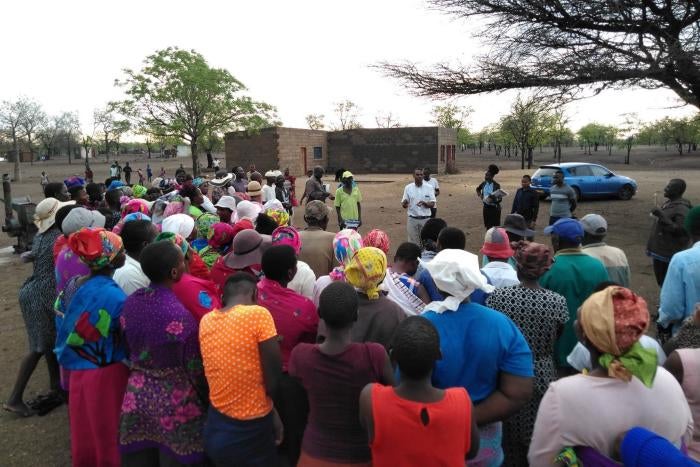
Masvingo residents arrested over peaceful water protest

MASVINGO Residents Trust secretary general Prosper Tiringindi was arrested Friday morning together with a group of women who converged at the Civic Centre to demonstrate over water. Masvingo has not had water for the last three weeks following a fault at a Zesa transformer at Lake Mutirikwi which is yet to be attended to. The group, carrying empty buckets, converged at the Civic Center before proceeding to the entrance to the mayor and town clerk’s offices. They were then arrested by the Municipal Police who later called in ZRP and they were whisked away to Masvingo Central (pictured). – The Mirror‬‬‬‬

A youthful political activist was severely tortured by State Security agents for attending MDC Alliance vice chairperson Hon Job Sikhala’s court session in Harare on Thursday.The young activist, Lengwani Mavhunga was also burnt with chemicals.

Zim increasingly becoming a dark and dangerous place for activism

BY BLESSING GORONGA

In 2017, Zimbabwe was thrown into euphoria, as long-time dictator Robert Mugabe was overthrown and replaced by Emmerson Mnangagwa, the former vice-president, who promised reform and a new dispensation.

Barely four years after those jubilant scenes that marked Mugabe’s fall, Zimbabwe is turning into a very dangerous place reminiscent of the dark days during the Unilateral Declaration of Independence by the Rhodesian Front in 1965 and the Gukurahundi era in the first few years of independence.

Firstly, Mnangagwa seems hell-bent on foisting a one-party state in Zimbabwe; a very archaic way of governing and an anathema to the democratisation process that is sweeping across Africa and the world.

In pursuit of this one party state agenda, Mnangagwa’s has a two-pronged approach which involves the incapacitation of the opposition and the co-option of willing activists, a model akin to China, where those allowed to “oppose” are literally chosen by the Chinese Communist Party.

I will start with the more dangerous aspect of Mnangagwa’s plan — the destruction of the opposition.

The past year has seen the jailing of activists who are vocal in opposing Mnangagwa, the most prominent being Joannah Mamombe — an opposition legislator and a Chevening scholar.

Prior to her jailing, Mamombe and a couple of colleagues were allegedly kidnapped by people believed to be linked to the state.

Following noise and campaigns from activists, foreign embassies including that of the United Kingdom, Mamombe was freed from captivity, but that was only the beginning of her ordeals.

Since then she has been arrested several times and as I write, she is held without bail together with Cecilia Chimbiri, with whom she was allegedly kidnapped together.

Another activist, Netsai Marova has faced similar persecution and the government has indicated that she may soon be arrested.

Just as with Mamombe and Chimbiri, she is likely to be denied bail.

Makomborero Haruzivishe, a member of MDC Alliance youth executive, is also behind bars without bail, while Allan Moyo, a university student leader, spent more than two and a half months in prison after being denied bail.

Takudzwa Ngadziore, another student leader has also spent several days in prison after being denied bail in very curious circumstances.

In terms of freedom of expression, which Mnangagwa promised to guarantee and which is guaranteed in the constitution, the current president may be as bad as or even worse than his predecessor.

Hopewell Chin’ono, a freelance journalist, has been arrested at least three times, while Mduduzi Mathuthu, the editor of ZimLive, has been forced into hiding.

Their only crime is that they exposed corruption in government circles and drew links between Mnangagwa’s family and graft in the procurement of Covid-19 equipment.

In the most egregious attack on freedom of the media, suspected state agents abducted and tortured Mathuthu’s nephew, Tawanda Muchehiwa, whom they held captive for three days.

His badly bruised body was showcased on Sky News in the United Kingdom and around the world.

As has become the norm, the government denied any involvement in the abduction, but as fate would have it, the whole thing was captured on CCTV.

The authorities have had no response since then.

I bring these examples because I want to show that criticising or standing up to Mnangagwa and his government is now a very dangerous vocation, with activists being thrown into jail at a whim.

In a normal situation, activists and the media are supposed to be a watchdog of the government, but not in Zimbabwe, where watching over the government could land anyone in jail.

Mnangagwa’s second strategy is the co-option of the opposition, with those who resist his overtures facing his wrath.

Nelson Chamisa, the leader of the MDC Alliance, the second biggest party in Zimbabwe at least by terms of votes in the last election, has had his organisation literally taken away from him.

Legislators from his party have been thrown out of parliament in the strangest circumstances, while his party headquarters have been taken away from him.

In total disregard of the voters’ choices, Chamisa’s legislators have been replaced with pliable opposition leaders who are not really opposed to Mnangagwa, but rather are agreeable to him.

Instead of having by-elections to fill in the vacant parliamentary seats, the government has banned the holding of elections in the most shameless attack on the country’s democracy and the constitution.

This is simply because the governing Zanu PF party is averse to opposition and criticism and literally wants to go it alone.

Zimbabwe is slipping into a very dark abyss, where all pretence of democratic governance shall be dispensed with, meaning it will increasingly become difficult for the opposition and activists to remain in the country.

Exile, no matter how uncomfortable, is increasingly becoming the best options for thousands of people whose only crime is that they dared to stand up and fight for freedom of association and freedom of expression.

The trouble with the Zimbabwean government is that they are polishing their propaganda and public relations act, where they portray themselves as victims rather than perpetrators of gross human rights abuses.

However, they cannot fool everyone all the time and the human rights abuses are increasingly coming to the fore.

If nothing is done to halt the excesses of the Zimbabwean government, the country will soon slide into an autocracy never before imagined, where the opposition is outlawed and all activists are behind bars.

Teachers’ union leader escapes abduction attempt, hides in maize fields

HARARE – Amalgamated Rural Teachers’ Union of Zimbabwe (ARTUZ) secretary-general Robson Chere survived an abduction attempt by four suspected state security agents on Sunday, the union said.

The alleged incident occurred around 9PM at the Arcturus mining community in Goromonzi, where the trade unionist was visiting with a friend.

Chere said the four men approached and tried to drag him into an IST white Toyota vehicle whose number plates he failed to make out because the car’s backlights were turned off.

Three of the suspects, the union leader said, were identified by locals as Wirimai Manyati, Carlos Kamudyariyo, and Munyaradzi Manyati, a Mutoko businessman affiliated with Zanu PF.

Kukurigo could not independently verify the alleged identities.

The unionist said he only survived after screaming hysterically, attracting the attention of a “security guard, storekeeper, and other locals” before seeking refuge at a nearby maize field where he hunkered down like a “lifeless corpse” until he was in the clear.

“I then went to my friend’s place where l slept in the bathroom fearing that the state agents were still pursuing my whereabouts and would return to abduct me,” Chere said via telephone.

“In the afternoon I reported the matter to the police, whose RB case number I’m yet to be given.”

Chere said he was now living in fear as he had been “abducted several times before” by state operators using the same “modus operandi” to deal with vocal teachers.

National police spokesman Paul Nyathi was not taking calls for comment.

Human rights defenders say Zimbabwe has seen a surge in state-sponsored kidnappings in the last three years after President Emmerson Mnangagwa came to power in a military coup that toppled the late Robert Mugabe.

Foreign Diplomats Demand Mnangagwa To Account For Missing Dzamara

Prof JONSO NAMES CIO WHO TORTURED DZAMARA
Itai Dzamara

PRESIDENT Emmerson Mnangagwa has come under renewed international pressure to account for missing journalist-cum-activist Itai Dzamara who was last seen in public six years ago.

In separate statements Wednesday, European Union, the US, UK, Canada and human rights groups slammed an “enduring culture of impunity” in Zimbabwe.

Dzamara, a fierce critic of the now late President Robert Mugabe was seized by suspected state security agents at barbershop in Glen View, a high density suburb in Harare March 9, 2015 and he has never been seen again.

Mugabe was toppled in a military coup in 2017 and died in 2019. Western embassies this week issued statements demanding that Mnangagwa’s administration should account for Dzamara’s disappearance.

“The culture of impunity in Zimbabwe needs to end. Government ought to shed light on his fate and ensure that justice is served for Itai and all other victims of human rights violations,” the EU mission in Zimbabwe said.

The US embassy in Harare called on the government to investigate Dzamara’s abduction fully and to bring to account those responsible.

“We stand with his family and all Zimbabweans who exercise their freedoms of expression and peaceful assembly,” the embassy said.

Canada said it was deeply concerned that six years after his disappearance Dzamara’s whereabouts remain unknown.

“We call on authorities to continue with their efforts to investigate his abduction and to ensure that those responsible are brought to justice,” the Canadian embassy said.

In a separate statement, the UK embassy said; “Itai Dzamara isn’t forgotten. He went missing six years ago, abducted from a barber’s shop in Harare. His relatives and friends still don’t know what happened to him.”

Local human rights groups have also castigated the government for showing lack of commitment in investigating his disappearance blaming the state for; “reluctant and uninterested in diligently looking into the matter”.

“Additionally, High Court judge, Justice David Mangota, ordered the police to fully investigate,” the Zimbabwe Human Rights NGO Forum said.

“However, no meaningful investigation has taken place as evidenced by the absence of any comprehensive reports submitted by the authorities to the courts,” the Zimbabwe Human Rights NGO Forum, a consortium of civic society organisations, said.

Zimbabwe: Thousands of Villagers Facing Eviction

Planned Displacements to Make Way for Commercial Venture

Staff from the Masvingo Centre for Research Advocacy and Development (MACRAD Trust) consult with members of the Chilonga community in Chiredzi.
Staff from the Masvingo Centre for Research Advocacy and Development (MACRAD Trust) consult with members of the Chilonga community in Chiredzi. © 2021 MACRAD Trust

(Johannesburg) – The Zimbabwe government is evicting thousands of people from an indigenous minority group from their communal land, Human Rights Watch said today. The order affects more than 13,000 people of the Shangani minority.

On February 26, 2021, the Local Government, Urban and Rural development Minister, July Moyo, published a legal notice ordering thousands of people occupying approximately 12,940 hectares of Chilonga communal land in Chiredzi, southeastern Zimbabwe, to leave immediately unless they acquire fresh rights of use or occupation to that land. The legal notice, Statutory Instrument 50 of 2021, said the land was being set aside for lucerne grass production – farming grass for stockfeed.

“The Zimbabwean government should stop these evictions that ignore the rights of indigenous communities and would leave thousands of people destitute and vulnerable – particularly during the Covid-19 pandemic,” said Dewa Mavhinga, Southern Africa director at Human Rights Watch. “The government should ensure that any eviction process is carried out only when it is strictly necessary, and follows due process, adequate prior consultation with those affected, adequate compensation, and provision of alternative land.” 

On March 4, the Information Ministry Permanent Secretary, Nick Mangwana, shared a video message on Twitter in which the parliament member for the Chiredzi West constituency, Farai Musikavanhu, claimed that the government had consulted the Shangani people of Chilonga and that they supported the lucerne grass production project. However, Human Rights Watch established that Musikavanhu is not the parliament member for the Chilonga area, and several Chilonga leaders told Human Rights Watch they are opposed to eviction and to the grass farming project by a private company.

On March 4, a Chilonga community leader told Human Rights Watch that the community rejected the lucerne farming plans because they were announced without the community’s consent. He also said that the government did not provide reasonable notice for relocation, plans to pay compensation, and provision of alternative land with infrastructure like schools, clinics, hospitals, and roads.

Another community leader told Human Rights Watch that, “We refuse to be forced to leave our homes without any reasonable notice, since the law says we must leave immediately, and without any compensation.”

Another said: “This is not the first forced eviction for the Shangani people in Chilonga community. In the 1960s the colonial government displaced us to Chiredzi from our ancestral lands to pave way for Gonarezhou National Park.”

Zimbabwe’s Communal Land Act, section 10, authorizes the local government minister to set aside communal land for any purpose, after consultation with the local Rural District Council. The law permits the minister to order evictions, under certain limited circumstances, including with reasonable notice and compliance with the country’s constitution. Section 74 of the Zimbabwe constitution prohibits eviction in the absence of a court order issued after considering all the relevant circumstances.

A staff member of a local civil society group working with the Chilonga community, the Masvingo Centre for Research Advocacy and Development (MACRAD Trust), told Human Rights Watch that on April 30, 2020, Minister Moyo met with traditional chiefs, local authorities, the headman of the community, and a few other delegates, to inform the local leadership of the government plan to convert the Chilonga communal area land into lucerne producing farms. The Chilonga community leaders, however, reject the eviction notice, which will affect 678 villages comprising 2,258 households with 13,840 people.

The MACRAD Trust and members of the Chilonga community, through their lawyers, the Zimbabwe Environmental Law Association (ZELA), on March 5 filed two urgent High Court motions to have the legal notice declared unconstitutional and invalid. The filing says that the order infringes on the right to not be subjected to arbitrary eviction, the right to fair administrative justice, and the right to dignity. The cases are pending.

Forced displacement without compensation, or forced evictions, violate international human rights law. The African Union Convention for the Protection and Assistance of Internally Displaced Persons in Africa, which Zimbabwe ratified, requires in Article 3(1)(a) that states parties “refrain from, prohibit and prevent arbitrary displacement of populations.”

The African Commission on Human and Peoples’ Rights has stated that communities’ traditional and collective ownership of land should be recognized and protected under the right to property. This includes protecting communities from forced evictions.

In General Comment 7, the UN Committee on Economic, Cultural, and Social Rights defines forced evictions as “the permanent or temporary removal against their will of individuals, families and/or communities from the homes and/or land which they occupy, without the provision of, and access to, appropriate forms of legal or other protection.”

The committee said that in keeping with their obligations under Article 11.1 of the International Covenant on Economic Social and Cultural Rights, and Article 17.1 of the International Covenant on Civil and Political Rights, governments should ensure that “prior to any evictions, particularly those involving large groups, all feasible alternatives are explored in consultation with affected people, with a view to avoiding, or at least minimizing, the use of force.” Governments should also ensure the rights of victims to adequate compensation for any property affected.

“The Mnangagwa government should do the right thing and treat the people of Chilonga with the respect and dignity they deserve by respecting their land and property rights and peacefully engaging with them on its plans,” Mavhinga said. “Forcibly evicting thousands of people amid a pandemic, without reasonable notice, compensation, and alternative land would be a wanton disregard of the country’s legal obligations.”

76 mourners arrested at chaotic burial of victim of police brutality

GWERU – Dozens of mourners were arrested in Gweru on Saturday after police disrupted the burial of a man who allegedly died after police beatings.

Tatenda Kasinyore’s death in police custody sparked anger in Mtapa suburb where he was popularly known as Nyale.

Before his burial, hundreds of people, some carrying placards, demonstrated outside Monomutapa Police Station where he had been detained. His coffin was for several minutes dumped outside the station, disrupting traffic on the Gweru-Matobo Road.

Police responded by firing teargas and followed the funeral procession to the local cemetery where 76 mourners were arrested, according to the Zimbabwe Human Rights NGO Forum.

Police spokesman Assistant Commissioner Paul Nyathi said their officers were enforcing Covid-19 regulations which limit the number of mourners to 30.

“We discovered that the people who had gathered for the funeral were exceeding 30 and police had to disperse people,” Nyathi said, before accusing unnamed human rights organisations of “taking advantage of the situation.”

Police were called to a house in Mambo suburb at about 2AM on Wednesday following reports of a man throwing stones on the roof.

Kasinyore, 28, was arrested at the scene where witnesses heard him complaining over tight police handcuffs.

He was taken to the police station where at around 4AM his two cellmates named as Tendai Magwaza and Tafadzwa Gojo called out for help when he started vomiting. An ambulance was called and he was pronounced dead on arrival at Gweru Provincial Hospital.

Nyathi said Kasinyore was drunk and had been found with the drug methamphetamine during a body search, popularly knows as mutoriro in the local Shona language.

Bad roads

This is Magaba in Mbare, Harare. The road is bad, not even good for pedestrians to walk on. Should we even call this a road? This is unacceptable. Meanwhile the current government keep looting at the public’s expense.

This is unhealthy and risky to so many diseases. Leaving the poor people vulnerable and as always leave the poor people to suffer because of poor resources at clinics, poor roads to get to the hospitals, poor services at the hospitals, poor governance. The sad part is not only Mbare is like this, but most areas in Harare are in this condition or worse. Something has to be done for a better Zimbabwe 🇿🇼

#Demloot