“This Police brutality gives a bad name to Zimbabwe as a rogue, pariah State that does not respect human rights. The police these abuses are rarely panished.” – Said Dewa Mavhinga
This is the reason we continue to demonstrate, protest and fight against human rights abuse. It pains that they (the government) continue to deny that there is no human right abuse in Zimbabwe when the video evidences are clear enough. We continue to see our brothers and sisters being abused and the authorities still deny these events. Where are we going as a nation when those that are supposed to protect us are the ones killing us?
Harare, Zimbabwe (CNN) – A Zimbabwe court has denied bail for prominent journalist Hopewell Chin’ono who is facing charges of inciting citizens to “participate in public violence.”
“He has been denied bail on the basis that he is a danger to the public and that, if he is released, he will continue advocating for violent protests,” Chin’ono’s representative, Beatrice Mtetwa, said.
“Justice delivery has been severely compromised. We will naturally be appealing to the High Court,” she added.
Chin’ono was arrested Monday alongside opposition leader Jacob Ngarivhume, accused of encouraging citizens on social media to “participate in public violence” during a protest scheduled to take place next Friday.
Both Chin’ono and Ngarivhume — who was also denied bail on Thursday — have denied the allegations.
The award-winning journalist was most recently working on allegations of corruption relating to the procurement of Covid-19 supplies by the health ministry, according to Amnesty International which accused the Zimbabwe government of using state’s security forces to silence critics.
In a statement, the United Nations High Commissioner for Human Rights called for an end to the “pattern of intimidation” seen in Zimbabwe, warning that authorities may be using the coronavirus pandemic as a pretext to “clamp down” on freedom of expression.
“We are concerned at allegations in Zimbabwe, which suggest that the authorities may be using the COVID-19 pandemic as a pretext to clamp down on freedom of expression and freedom of peaceful assembly and association,” a spokesperson for High Commissioner Liz Throssell said Friday.
“It is important to remind the authorities that any lockdown measures and restrictions should be necessary, proportionate and time-limited, and enforced humanely without resorting to unnecessary or excessive force,” Throssell’s aide added.
Addressing the arrest of Chin’ono and Ngarivhume, the UN High Commissioner called on the Zimbabwean government to uphold its human rights obligations.
“Merely calling for a peaceful protest or participating in a peaceful protest are an exercise of recognized human rights,” Throssell’s spokesperson said.
“The arrests of Hopewell Chin’ono and Jacob Ngarivhume are designed to intimidate and send a chilling message to journalists, whistleblowers and activists who draw attention to matters of public interest in Zimbabwe,” said Deprose Muchena, Amnesty’s director for east and southern Africa in a statement.
In May, three female opposition members, who said they were kidnapped by security forces for days after they left a rally calling for better coronavirus palliatives for citizens, are in jail.
The women, also charged with breaking lockdown regulations, said they were tortured and sexually assaulted after their arrests but the government has accused them of faking their abductions.
Hopewell Chin’ono is facing charges carrying up to 10 years in prison
Journalists are not above the law. Lawyers are not above the law. Doctors and nurses are not above the law. Politicians and bankers are not above the law. Anyone suspected to have committed a crime should be subjected to due process,” Nick Mangwana, Zimbabwe’s secretary for information, declared.
But many now being “subjected to the process” in Zimbabwe are those who have who have one thing in common – opposing those in power. And, in the case of Hopewell Chin’ono, there is the added factor of holding up the government to rigorous journalistic scrutiny.
Chin’ono’s arrest followed an investigation by him that exposed how establishment figures were profiting from massive coronavirus-related financial contracts while the country, impoverished with a shattered infrastructure, suffers the devastating effects of the pandemic.
A magistrates court in the capital, Harare, denied Chin’ono bail this week, giving a curfew imposed over the pandemic as the reason for postponing the hearing. He faces charges of incitement of public violence carrying a sentence of ten years in prison on conviction.
Colleagues from the international media had met Chin’ono and many of his colleagues while covering the fall of Robert Mugabe and the subsequent election. There was, at the time, great hope that four decades of often brutal authoritarian rule would be followed, at last, by establishment of basic freedoms.
But the government of Emmerson Mnangagwa, from Mugabe’s ZANU-PF party, has been repeatedly accused of bringing back the repression of the past. Journalists seeking to reveal malpractice and corruption have found themselves in the firing line.
Chin’ono’s reports led to the arrest and and subsequent sacking last month of health minister Obadiah Moyo for allegedly awarding government contracts of £47m for test kits and personal protection equipments at inflated costs.
But at the same time Chin’ono began to come under attack from ZANU-PF. At one point he told friends and colleagues that he was apprehensive of physical attacks, even attempts on his life. Patrick Chinamasa, a party spokesman, accused him of seeking to embarrass President Mnangagwa by linking his family to the contract scandal. Another official, Tafadzwa Mugwadi, warned that the journalist and others arrested cannot expect an early release: “Our institutions do not arrest criminals so that they can free them,” he said.
The authorities hold that the accusation against Chin’ono, of inciting violence result, arose from tweets he sent asking people to attend a protest march against corruption next week. They claimed that the demonstration was an attempt to weaken security and undermine the government while it is dealing with the Covid-19 emergency.
There has been a spate of detentions recently in Zimbabwe. An opposition leader, Jacob Ngarivhume, was arrested for the same call to protest as Chin’ono. A dozen health-workers were arrested earlier this month during a march called in protest over poor pay and conditions. Three female opposition activists claimed that they suffered torture, including sexual abuse, after being forcibly taken away by security forces as they were leaving a rally against the government’s handling of the coronavirus crisis.
There has been international condemnation over Chin’ono’s arrest. The European Union mission stressed that “journalism is a crucial pillar of any democratic society and the fight against corruption”.
The US Embassy stated “independent media plays a vital role in the exchange of information and ideas, and no journalist should be threatened or arrested for doing their job”.
This may well elicit a hollow laughter from journalists in America where the media is regularly subjected to vitriolic abuse, and portrayed as the enemy, by Donald Trump. Many have been threatened, attacked and arrested for doing their job recently, reporting on the protests which followed the killing of George Floyd. This has included The Independent’s correspondent, Andrew Buncombe, who was detained, assaulted and shackled while covering a police operation in Seattle. In response, The Independent launched its Journalism Is Not A Crime campaign to call for the protection of reporters.
Freedom of the press continue to be under threat from those in power in Zimbabwe.
If the police are doing this for taking photographs what more of the robbers, thieves, murderers? What kind of behaviour is this? And what are the leaders saying about this kind of behaviour?
Healthcare workers protest against poor remuneration. We have a corrupt, anti-poor government that facilitated the looting of US$60 million under the guise of supplying Covid19 sundries yet the won’t pay frontline workers a living wage.
They keep hiking prices but don’t want to pay the frontline workers. #ZanuPFMustGo
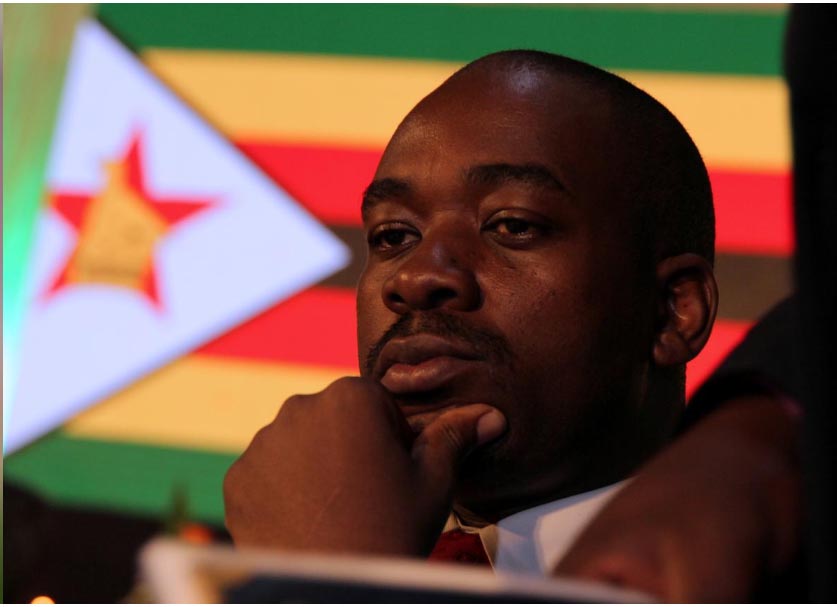
Zimbabwe’s Supreme Court on Tuesday declared Nelson Chamisa’s leadership of the main opposition MDC was illegitimate and ordered it to hold an election to replace him within three months, potentially weakening an already fractured movement.FILE PHOTO: Opposition Movement for Democratic Change (MDC) leader Nelson Chamisa attends a media briefing in Harare, Zimbabwe, January 29, 2019.
Chamisa’s deputy rejected the ruling and said it was an attempt by the government to usurp the party.
Chamisa, 42, narrowly lost the 2018 presidential vote to Emmerson Mnangagwa. He accused Mnangagwa of rigging the vote and does not recognize his presidency.
He has refused to join political talks with the president over the country’s economic crisis and ways to solve the intractable political disputes stemming from that election in the absence of a foreign mediator.
The case against Chamisa was brought by a member of a rival faction of his MDC (Movement for Democratic Change). The court said the process that made Chamisa acting party president after Morgan Tsvangirai died in February 2018 was illegal and therefore null and void.
Police had already sealed off the MDC headquarters in Harare to prevent Chamisa’s executives from entering the building.
The ruling could open the door to Chamisa’s rival, Thokozani Khupe, who leads the smaller rival MDC faction and has been angling to take over the leadership of the larger MDC movement.
But political analysts said the ruling could be academic, with Chamisa still enjoying popular support from grassroots MDC members who elected him, unopposed, as their permanent leader at a congress last year.
“My position is that we as MDC we held our congress in May 2019. Nelson Chamisa is our president and our next congress is 2024. Full stop,” MDC vice president Tendai Biti told reporters.
“The government is trying to usurp our party.”
Supporters of Chamisa accuse the ruling ZANU-PF party of using the courts to emasculate the MDC and to force him to accept Mnangagwa as legitimately elected.
Tuesday’s ruling follows a similar judgment by a lower court last year when Chamisa was acting head of the party. Chamisa appealed against that ruling. He would have to raise constitutional issues with the Constitutional Court to appeal against this judgment.
The Movement for Democratic Change (MDC-T) led by Thokozani Khupe claims that it has taken over Morgan Richard Tsvangirai House.
According to some MDC-T activists, several party members visited the office Thursday evening in Harare, which was being used by Nelson Chamisa’s MDC Alliance, and asked the youth found in the building to leave.
MDC-T’s organizing secretary for Harare province, Rhino Mashaya, told VOA Studio 7 that they took over the office without a fight.
“Some of the MDC Alliance youth guarding the premises called our members and asked them to take over the offices. Our youth in the Harare central business district went there and did that. There was no resistance at all as that office belongs to us.”
He dismissed as “wishful thinking” reports that the MDC-T was assisted by the Zimbabwe Defence Forces in taking over the building.
Chamisa’s spokesperson, Dr. Nkululeko Sibanda, was unreachable for comment as he was not responding to calls on his mobile phone.
Sibanda recently attacked MDC-T saying the party is now allegedly working with Zanu PF in an attempt to cripple the opposition party.
The Supreme Court sometime this year ruled that Chamisa is not the legitimate leader of the MDC and ordered it to hold an extraordinary congress to replace the late founding president Morgan Tsvangirai.
‘We are the rightful owners of the building and you have had no court order to stop us from entering’
Held … Arrested MDC officials with their lawyer Advocate Thabani Mpofu at the Harare Central Police Station on Friday evening
HARARE – Police arrested five senior MDC Alliance officials on Friday after they attempted to enter the party’s Harare headquarters, which is being occupied by a rival faction.
The Movement for Democratic Change (MDC) was thrown into turmoil by a March 30 Supreme Court ruling which said Nelson Chamisa’s ascendancy to the MDC-T party leadership was irregular – but Chamisa had by then formed the MDC Alliance party, which contested the July 2018 elections, winning 110 seats in the National Assembly and Senate.
Thokozani Khupe, Chamisa’s leadership rival in the MDC-T who participated in that election as leader of the MDC-T, won two seats.
Most MDC members still regard Chamisa as their leader and accuse President Emmerson Mnangagwa’s government of siding with Khupe’s faction in the battle for control of the movement.
Supporters of Khupe, using the court ruling, seized control of the MDC Alliance’s offices at Harvest House late on Thursday while police and soldiers watched, a video of the incident circulated by the MDC showed.
Anti-riot police on Friday cordoned off the building, which has stood as a symbol of the MDC’s fight against Mnangagwa’s ruling Zanu PF party for the past two decades.
Some MDC Alliance officials, led by party vice presidents Lynnette Karenyi-Kore and former finance minister Tendai Biti, then tried to enter Harvest House.
“We are the rightful owners of the building and you have had no court order to stop us from entering,” Biti told the police officers blocking their way.
He and four other MDC officials were arrested and transported to a police station in a lorry. It was not immediately clear what charges they would face.Prisoners … MDC officials including vice presidents Biti and Kore are transported to the police station on the back of a truck
Police spokesman Paul Nyathi said he had no details of the arrests.
Chamisa says his party is different from Khupe’s outfit after it contested elections in 2018 under the name MDC Alliance while Khupe’s ran as the MDC-T party.
Chamisa, 42, polled over 2.1 million votes, narrowly losing to Mnangagwa. Khupe was a distant third with just over 45,000 votes.
Chamisa says he is being persecuted for refusing to recognise the president’s disputed victory while Khupe accepted the results.
Chamisa’s MDC Alliance accuses Mnangagwa’s government of eroding political rights under the cover of Zimbabwe’s coronavirus lockdown, which includes a ban on political protests.
In a statement, the United States embassy in Harare said: “We are dismayed by the politicised use of security forces to take over the headquarters of an opposition party and arrest its members. A healthy democracy requires healthy opposition parties.”
Huge majority of MDC Alliance lawmakers defy Khupe threats of recall and stay away from Parliament
Opposition chaos … MDC Alliance leader Nelson Chamisa has laughed off purported expulsion by Thokozani Khupe from the MDC-T.
HARARE – Nineteen MDC Alliance MPs defied a party directive to boycott Parliament on Tuesday, but the rebellion was far short of the numbers Thokozani Khupe needed to convince her backers that she can seize control of the party.
Khupe, leader of the MDC-T party, simultaneously announced that she had expelled MDC Alliance leader Nelson Chamisa, adding to the chaos in the opposition ranks triggered by a Supreme Court judgement in April.
Among the MDC Alliance MPs who turned up in parliament were Hatfield lawmaker Tapiwa Mashakada, Kariba MP John Houghton and Glen View South MP Vincent Tsvangirai, the son of the party’s founding leader, the late Morgan Tsvangirai.
Mashakada said he still supported Chamisa, but disagreed with the strategy to boycott parliament announced after Khupe recalled four MDC Alliance lawmakers.
Khupe is now effectively in charge of two parties in parliament, her MDC-T which has one MP and the MDC Alliance with 84 MPs – a political farce which the MDC Alliance is currently challenging at the High Court.
Political analyst Alex Magaisa said Khupe was hoping for a more impressive turn-up in Parliament.
He said: “She should be concerned, surely, after being supposedly given title to the party (MDC Alliance) by the courts and to the MPs by the Speaker of the National Assembly and President of the Senate. If she cannot command the MPs, what more the ordinary people?”
The MDC chaos was occasioned by a controversial Supreme Court ruling in April. The apex court had been asked to rule on two substantive issues on appeal from the High Court by Chamisa. The first was whether appointments of deputy presidents made by the founding president of the MDC-T, Morgan Tsvangirai, in 2016 were lawful.
The second concerned the legality of Chamisa’s rise to become interim leader of the MDC-T in February 2018, following Tsvangirai’s death. Khupe insisted that the MDC-T constitution entitled her to lead, as the only vice president elected at the last congress in 2014.
The Supreme Court upheld the decision of the High Court that there were illegalities in both instances. The court determined that the MDC-T should revert to the pre-2016 structures before Tsvangirai’s elevation of Chamisa and Elias Mudzuri to form a tripartite vice presidency with Khupe.
It also ordered that the MDC-T should hold an Extraordinary Congress within three months from the date of the judgment.
The decision of the court split opinions about its consequences for opposition politics. Khupe – who contested the July 2018 election as MDC-T leader while Chamisa led the MDC Alliance – sought to assert control as leader of the MDC Alliance.
Khupe recalled four MDC MPs and senators, forcing the MDC Alliance to order its lawmakers to stop attending parliament.
Most officials who held positions in the MDC-T structures of 2016 are in the MDC Alliance, some of them MPs, and Khupe has used the threat of recall – with the attendant loss of pensions and means of survival for some of the MPs – to try and whip them into line.
The decision to “expel” Chamisa, announced by Douglas Mwonzora who says he has reprised his former role as MDC-T secretary general, appeared aimed at thwarting any possibility of his nomination at the Extraordinary Congress which he maintains has nothing to do with his MDC Alliance party.
In a letter addressed to Chamisa, dated June 1, Mwonzora wrote: “I note that following the Supreme Court judgement, in MDC and Others v Elias Mashavira and Others (SC56/2020) of 31 March 2020, which ruled that you were no longer the President of the Movement for Democratic Change which was formerly led by the late Dr Morgan Tsvangirai, you have continued to defy the court order.
“The latest incident is when on 21 May 2020 you issued a communication to the effect that you had in your capacity as the President of the MDC Alliance party made certain appointments and redeployments to the party’s National Standing Committee. You could only have made these appointments as president of the party other than the party that was referred to in the Supreme Court judgement in the case mentioned above.”
Mwonzora said in terms of clause 5.10.(a) of the MDC-T constitution, Chamisa had automatically terminated his membership to the party by joining or forming another party.
Chamisa’s spokesman Nkululeko Sibanda said Mwonzora’s letter was part of “Zanu PF machinations to take over the MDC Alliance which would ultimately fail.”
The for MDC Alliance MPs have gone to court to challenge their expulsion from Parliament, arguing that Khupe’s recall was a legal nullity as they were not elected on an MDC-T ticket. The matter could potentially spill back into the Supreme Court which will get a second opportunity to untangle the political mess.




 Talk Rights